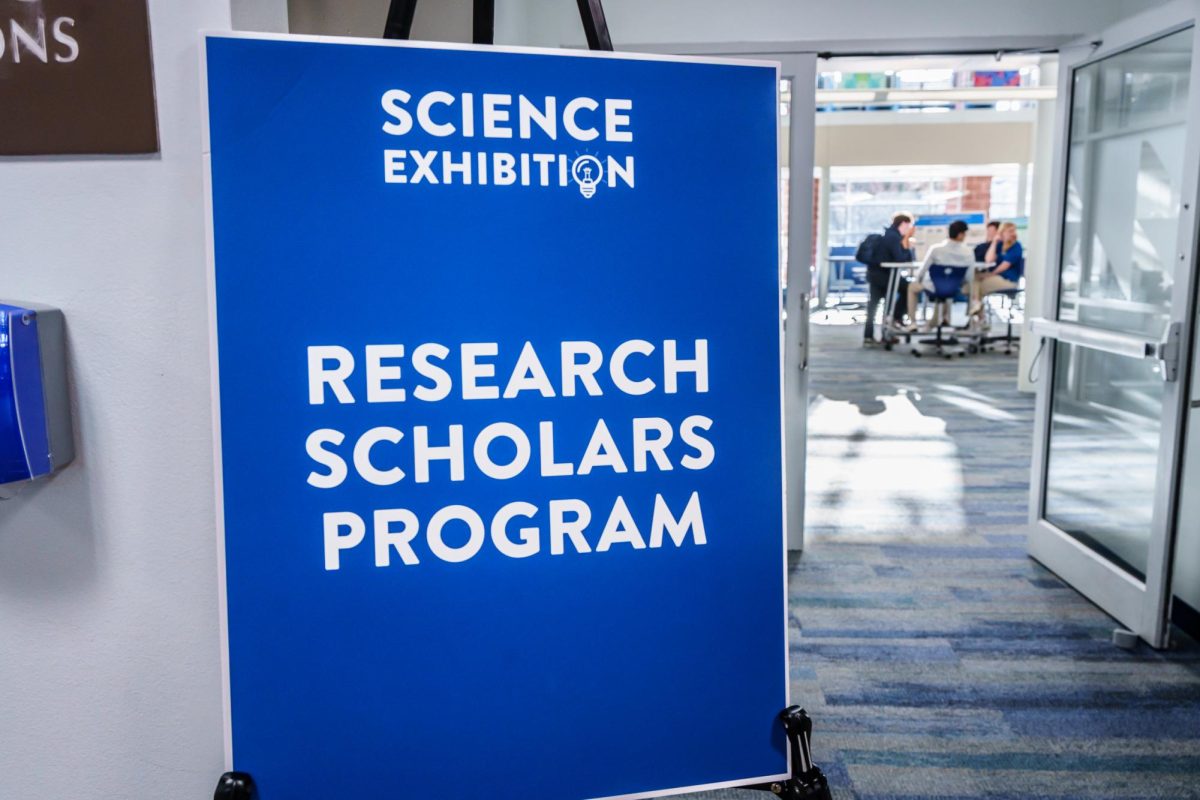
From allergenic reaction studies to atomic emission spectroscopy of lightning, our upper school students showcased their academic excellence and aspiration to pursue greater scholarly research at Flint Hill’s inaugural Science Exhibition in February.
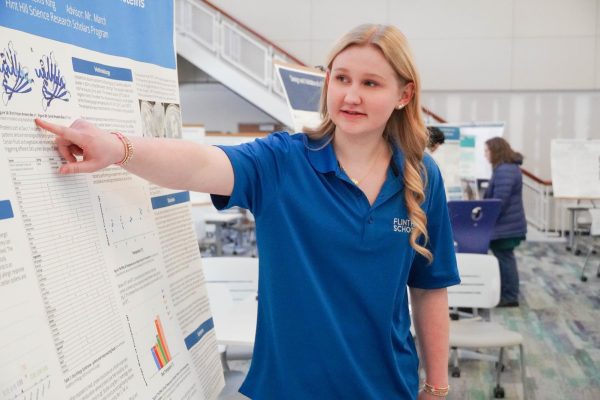
Just three years ago, Senior Alexis King (‘26) began her research project, piloting the program at Flint Hill. Her work spanned multiple disciplines of medicine and allergenic research to discover the “why” behind food allergies and denaturation, and how they affect her. Recently, she showcased her work to the research scholar mentorship board, becoming one of the first Flint Hill students to successfully pass her research study and marking her as an exemplary model of a true academic scholar who grounds herself in finding the answers to far-unanswered questions.
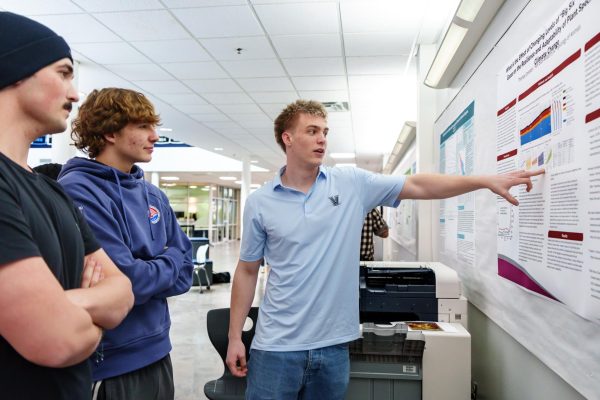
Along with the exhibition, our Upper School Huskies who had successfully completed their Advanced Biology final projects had the opportunity to print and publish their work at the event. Pictured to the right is Senior Thomas Carstater (‘26), who completed a literature review in his advanced biology class on plants’ resistance to the “big six” greenhouse gases. The opportunity to go beyond just learning concepts to delve deep into a specific question relating to biology showcases that research sits at the core of what the science department represents at Flint Hill. As students progress from physics to chemistry to biology, they learn to foster a deep connection to a topic they are truly passionate about, whether that be gearing their chemistry toward the environment by taking environmental chemistry to taking plant and animal physiology with dissections.
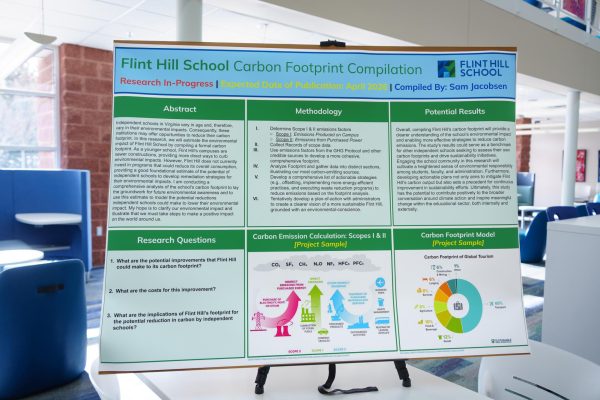
Courtesy of Flint Hill School
Showcased at the event, Sam Jacobsen (‘26) is working to compile a total carbon footprint of Flint Hill so that he can leave the school with a pathway forward to a sustainable future. Prior to COVID-19, Flint Hill had a multitude of programs, such as recycling and composting, that helped reduce net emissions and taught students to lead with an environmentally conscious mind. However, post-pandemic, the school has yet to implement additional environmental solutions; his research serves as a guiding light on the potential to reduce our carbon footprint.
The research scholars program and the substantial research opportunities in Flint Hill’s advanced biology classes allow students to engage in topics they are truly passionate about. One of Flint Hill’s core values is Imagining What’s Possible; thank you to all of those who went above and beyond to pursue the world’s most pressing questions and present them with pride at this event. Research remains crucial to deciphering the unknown, and the community looks forward to seeing the continued research work in the coming year.